

When the ATLAS survey telescope in Chile first picked up 3I/ATLAS in mid‑2025, it looked like just another faint moving dot against the background stars. Only after follow‑up observations came in from other observatories did astronomers recognise that its path through space was highly unusual. Instead of following an elliptical orbit around the Sun like normal comets, its trajectory was strongly hyperbolic, meaning it was passing through the solar system once and would never return. That is the tell‑tale signature of an interstellar visitor.
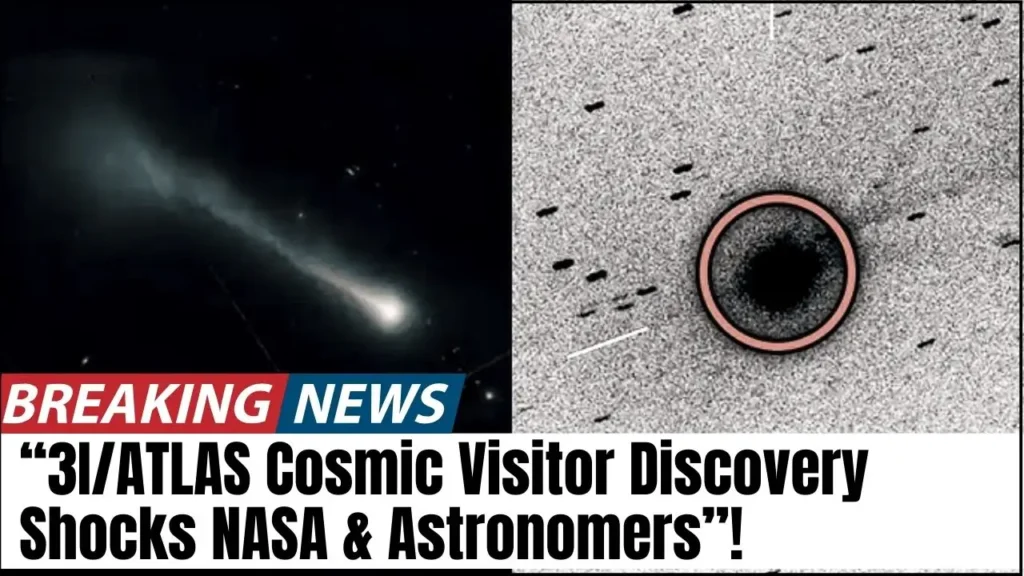
What truly justified the phrase “they have never seen this before,” though, was not just its path but its behaviour. Even while relatively far from the Sun, 3I/ATLAS showed signs of intense activity: bright jets of material, complex dust structures and an overall level of outgassing that seemed extreme for its distance. As more powerful telescopes zoomed in, they revealed a bright, apparently giant core surrounded by huge jets and twin “anti‑tails” pointing toward the Sun. These strange features are rarely seen together in any comet, let alone in one from another star system.
Table of Contents
3I/ATLAS Cosmic Visitor
| Key Detail | What We Know So Far |
|---|---|
| Object Name | 3I/ATLAS (also designated C/2025 N1 ATLAS) |
| Type Of Object | Interstellar comet / interstellar object |
| Discovery Survey | ATLAS – Asteroid Terrestrial‑impact Last Alert System in Chile |
| Discovery Timeframe | First reported in mid‑2025, with pre‑discovery images from earlier that year |
| Origin | Came from outside our solar system on a hyperbolic path |
| Closest Approach to the Sun | Around late 2025, roughly near the orbit of Mars |
| Distance From Earth at Closest | Hundreds of millions of kilometres; no impact threat |
| Standout Visual Features | Giant‑looking core, powerful jets, twin sunward anti‑tails, extended dust wings |
| Scientific Highlight | Rare opportunity to study the chemistry and structure of a comet from another star |
| Possible Life‑Related Ingredients | Contains water, carbon‑bearing molecules and complex ices linked to prebiotic chemistry |
| Observation Campaign | Monitored by major ground telescopes and multiple spacecraft across the solar system |
A First Look That Left Astronomers Stunned
The real “shock moment” for many astronomers came when the first detailed images of 3I/ATLAS were processed and shared. Instead of the fairly simple coma and tail expected from a typical comet, the images showed a bright, condensed central region and enormous jet structures extending outward. On top of that, there were two striking anti‑tails, dust features that appear to point toward the Sun rather than away from it. These features form under special geometric and dynamical conditions, but seeing such clear twin anti‑tails on an interstellar comet was completely unexpected.
On human scales, it is easy to underestimate what “enormous” means here. The jet and dust structures are so vast that no existing spacecraft could realistically fly close to the core without facing major risks from high‑speed particles. Even missions like JUICE or Juno, which happen to pass in the broader neighbourhood of the comet, can only observe it safely from large distances. In practical terms, 3I/ATLAS has become a “look, don’t touch” natural experiment, where telescopes must do all the work that a dedicated flyby mission would normally handle.
Why This Interstellar Comet Is So Different
Most comets seen in the inner solar system are icy leftovers from our own planetary outskirts, so astronomers have built models that can usually explain their size, brightness and behaviour. 3I/ATLAS does not fit neatly into those models. Early estimates suggest that it may be vastly more massive than ʻOumuamua, possibly by a factor of around a million, and significantly larger than typical comets that regularly visit the inner solar system. Its level of activity, even at relatively large distances from the Sun, also seems unusually high.
This raises important questions. How does a planetary system form and then eject such a huge comet into interstellar space? Are giant interstellar comets common and we have just been lucky to catch one, or is 3I/ATLAS a true outlier? If many similar objects are constantly drifting through the galaxy, then the number, size distribution and total mass of interstellar bodies may be far higher than previous estimates suggested. That in turn would affect models of planetary formation and the long‑term evolution of planetary systems.
Chemistry, “Ingredients for Life” And What It Carries
Beyond the visuals, one of the most exciting aspects of 3I/ATLAS is its chemistry. Spectroscopic observations indicate that it releases water vapour, carbon‑based molecules and other volatile ices commonly linked to the building blocks of life. Some measurements hint at unusual ratios of carbon and other elements, suggesting that this comet may be extremely old and chemically rich, shaped by conditions in a star system different from our own.
For astrobiologists, that is a big deal. Interstellar comets like 3I/ATLAS are effectively frozen samples from other planetary nurseries, preserved for billions of years before drifting through our neighbourhood. If they routinely carry water and complex carbon chemistry, then they may play a role in transporting prebiotic ingredients from one system to another. It does not mean the comet carries life, but it supports the idea that the basic raw materials for life can be widely spread across the galaxy.
How NASA And Global Telescopes Are Watching It
Because 3I/ATLAS will only pass through the solar system once, space agencies and observatories have moved quickly to coordinate observations. NASA and other organisations are using a “multi‑lens” approach: combining data from ground‑based telescopes, Earth‑orbiting observatories and spacecraft scattered around the solar system. Probes in orbit around Mars, Jupiter and other locations can see the comet from different angles, giving a three‑dimensional picture of its tail, coma and interaction with the solar wind.
Different wavelengths reveal different layers of the story. Optical and infrared images show dust, ice and jets; ultraviolet and X‑ray observations reveal how solar radiation and charged particles strip material from the comet and energise its gases. By stitching together all these datasets, scientists can track how 3I/ATLAS changes as it approaches and then recedes from the Sun, building a detailed timeline of its activity. Every step along this path helps refine models for how interstellar comets behave and how they respond to a new star’s environment.
What 3I/ATLAS Reveals About Other Star Systems
- Each interstellar object that passes through our solar system is like receiving a sample‑return mission for free, and 3I/ATLAS may be the best sample so far. Its size, structure and chemistry suggest that the planetary system it came from may be older and more dynamically active than ours, capable of flinging out massive icy bodies over time. The fact that it reached us implies a long, slow journey through interstellar space, enduring cosmic rays, dust impacts and temperature extremes without losing all its volatile material.
- By comparing 3I/ATLAS with ʻOumuamua and Borisov, astronomers can begin to map out how diverse interstellar visitors really are. ʻOumuamua appeared small and oddly shaped with little visible activity, Borisov looked more like a typical comet from our own system, and 3I/ATLAS seems to be a hyperactive giant with complex structures. That range alone hints that planetary systems across the Milky Way produce a wide variety of icy and rocky leftovers. Over time, as more such objects are found, they will provide a statistical picture of how common different types of bodies are and what that means for planet formation and habitability.
FAQs on 3I/ATLAS Cosmic Visitor
1. Is 3I/ATLAS Dangerous for Earth?
No. Current trajectory calculations show that 3I/ATLAS will remain extremely far from Earth, at distances of hundreds of millions of kilometres. It poses no impact risk and is purely an observational target.
2. Why Is the Discovery Described as Something Astronomers Have Never Seen Before?
The phrase highlights the combination of features that make 3I/ATLAS unique: its interstellar origin, possible enormous mass, powerful jets, twin anti‑tails and rich chemistry.
3. How Is 3I/ATLAS Different From ʻOumuamua And Borisov?
ʻOumuamua looked small, elongated and mostly inactive, while Borisov behaved more like a conventional comet from our own system.
4. Could 3I/ATLAS Be an Artificial Object or Alien Spacecraft?
The available evidence strongly supports a natural explanation. Its behaviour matches what would be expected from a volatile‑rich comet responding to solar heating.